
Witch Burning
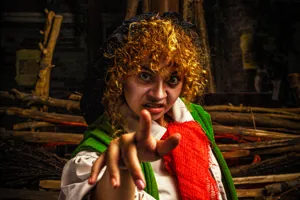
What do you do with a burning desire?
In the middle of the Nieuwmarkt, all eyes are focused on the still empty pyre. Here, the witch hunter is ready to point out his next witch and burn it alive.
What witch is responsible for sinful acts? The witch hunter finds his witch and has "conclusive" proof that she is guilty. Things are heating up out here!
Book now!
Historical background
Witches were burnt in the Netherlands for over two centuries: from 1472 to 1674. These people – mainly women – were killed because they were alleged to have used magic to make others ill, or in some cases even to murder them. They were said to be worshippers of the devil who all flew on broomsticks and held secret meetings at night.
A pact with the devil was the most horrific crime imaginable in the late Middle Ages. According to theologians, anyone who practised witchcraft placed themselves outside (Christian) society. Burning at the stake was the only appropriate way to rid society of such witches.
In the 16th century, the burning of witches was regarded as a just punishment.
It was often the vulnerable, poor, single women with no education who were easy targets for inquisitors acting on behalf of the Church or the authorities, but also for the general public. That does not, however, mean that all those accused of witchcraft were old, pockmarked women. The Utrecht ‘witch’ Hendrikje Folkerts was only seventeen years old.
WITCH TRIALS
There were various ways of determining who was a witch and who was not:
There was the water test, or floating test, in which a witch was thrown into the water whilst bound. If she floated, she was deemed a witch and sentenced. If she sank, she was not a witch, but still met her end by drowning.
Another popular method was to weigh someone on the witch’s scales. This was a large set of scales used to determine the weight of alleged witches. According to the stories, witches were said to be very light – which is why they could fly on broomsticks – so if a woman weighed the same as an ‘ordinary’ person, she was deemed innocent. In most cases, these scales were rigged so that anyone standing on them would automatically appear very light, and would therefore be branded a witch.
THE HAMMER OF WITCHES
In 1486, a book by the publisher Johan Prüss was published in Cologne: *Malleus Maleficarum*, or the *Hammer of Witches*. The Malleus Maleficarum contains an immense amount of pathological misogyny. Every woman is accused of witchcraft, from a devout nun to a woman with children. Little is said about men in the Malleus Maleficarum. A man is threatened if he were to assist an accused woman. For that crime, he deserves the death penalty. He is then himself unmasked as a sorcerer. Right up until the 17th century, the *Malleus Maleficarum* remained the basis for the witch hunts.


