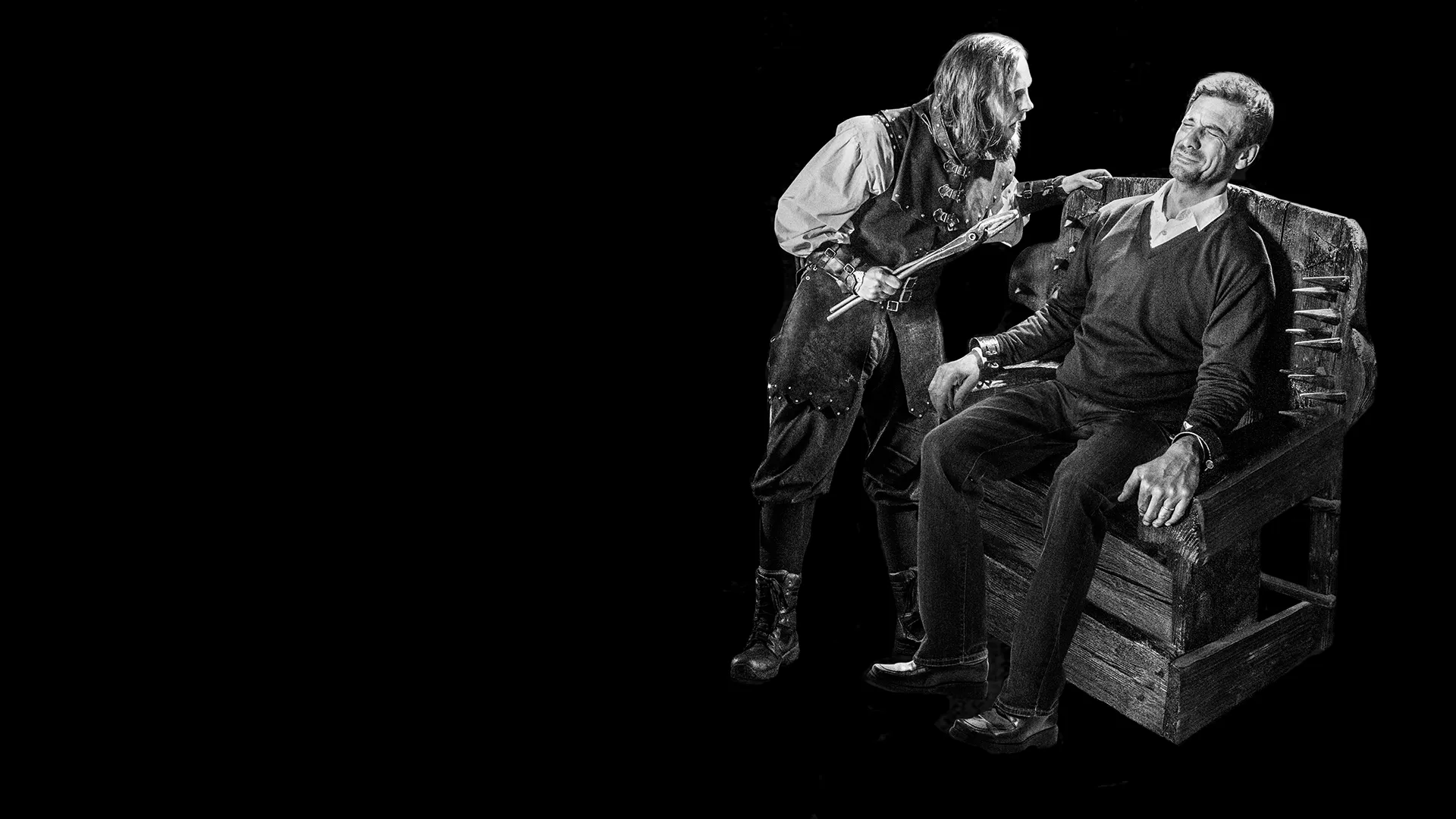
The Torture Chamber
Are you ready for the ordeal?
The smell of rotting flesh and the pleas for mercy will make you shiver with fear… Death is just around the corner (literally).
It is dark around you, you will hear the footsteps of the cold-blooded torturer come closer and closer. You will witness real-life corporal punishment. The hairs on the back of your neck will stand up when you realise that The Torturer is on his way to you! You will stand eye-to-eye with the sadistic martyr, his cold eyes tell you that there is no mercy.
Buy nowHistorical background
An executioner: a terrifying man. A barbarian wearing a black hood and wielding an axe. To some, he was the embodiment of a monster; to thieves and murderers, he was justice in action.
In short, the executioner carried out sentences. These were often corporal punishments, such as the amputation of body parts, flogging and branding; and if a serious crime had been committed, the executioner had to carry out the death penalty. The death penalty and practices of torture have been in use since the dawn of time. With the rise of Christianity, the practice of torture declined, but divine judgement became a much more widespread practice. This involved determining God’s will, and thus the guilt or innocence of the accused, by means of a trial by water or fire.
In the 15th century, torture came to play an increasingly significant role in the administration of justice. During torture, care was taken to ensure that the victim was not injured too severely, so that they could still appear before the judge in a presentable state.
A great burden rested on the executioner’s shoulders, for he had to carry out his duties skilfully. That was less easy than it seemed. For instance, during a beheading, the executioner had to sever the head from the torso in a single stroke. In some regions, it was even stipulated that the beheading had to take place in no more than three strokes. If he failed to do so, the executioner would face the wrath of the people. That wrath was not to be underestimated, as executions were often public affairs, attracting huge crowds. A mistake was easily made, and the highly volatile medieval crowd would then rush at him. If the executioner survived this fury, the authorities might still punish him. An executioner had to be careful in any case, as relatives of the condemned sometimes sought revenge on him. He therefore had to keep a low profile. He often lived near the city walls, so as not to cause any trouble.
Executioners did not choose the profession themselves, but were drawn into it through their fathers. In their youth, they first practised on fruit, then on dogs and pigs, and subsequently the ‘real’ work began, helping their fathers with torture, for example. Once an executioner, there was no turning back. The rest of society no longer wished to be associated with them.


